A lot of window cleaners hit the same wall at the same point. The work is lined up, the route is getting tighter, and then a property manager emails over insurance requirements that read like a foreign language. General liability. Additional insured. Workers' comp. Auto. Higher limits for a mid-rise. Suddenly, the question isn't “Can the crew do the job?” It's “Can the business qualify for the job?”
That's where window cleaning insurance stops being paperwork and starts acting like a business tool. A one-person residential operator doesn't face the same exposure as a contractor bidding retail storefronts, hotels, or work above three stories. The right setup can help a cleaner take on better contracts, satisfy client requirements, and avoid getting wiped out by one broken window, one ladder fall, or one bad subcontractor decision.
Table of Contents
- More Than Just Paperwork
- The Three Essential Policies for Window Cleaners
- Protecting Your Tools and Equipment
- Critical Endorsements and Hidden Coverage Gaps
- How Your Premiums Are Calculated
- Using COIs and Managing Subcontractor Risk
- Get the Right Coverage for Your Business
More Than Just Paperwork
A common scenario looks like this. A cleaner spends years building a solid residential book, then gets a shot at a better-paying commercial account. The walkthrough goes well. The scope is straightforward. Then the client sends over insurance requirements, and the cleaner realizes the policy that worked for storefronts and houses may not satisfy a mid-rise owner, a management company, or a national tenant.
That's the first hard lesson in this trade. Insurance isn't a box to check once and forget. It has to match the kind of work the business is doing, the height, the contracts being signed, the vehicles on the road, and whether employees or subs are involved.
A residential route might mainly need basic protection for slip hazards, damaged property, and vehicle use. A larger commercial bid raises different issues. The client may want higher liability limits, proof of workers' comp, and a clean certificate package. They may also ask for forms that many cleaners don't understand until a deal is already on the line, including requests that are tied to vendor certificate requirements.
Insurance becomes a sales problem the moment a client asks for proof that the contractor is qualified to step on site.
There's also an operations side to this. Once a cleaner starts hiring, scheduling crews, or assigning jobs across multiple locations, internal process matters just as much as policy limits. The same discipline behind Defensible HR practices in Tampa applies here. Clear hiring, training, and documentation habits help support safer operations and cleaner insurance conversations when something goes wrong.
Residential work and commercial work are not the same risk
A one-truck operation cleaning first- and second-story homes faces a very different exposure than a contractor sending techs to a retail center with public foot traffic and glass panels under active handling all day. The first business may be mostly worried about a ladder incident, minor property damage, or a van accident. The second may need to think about client contract language, larger claim potential, and whether the policy even contemplates the building height.
That difference matters because the cheapest policy often works only until the business grows. Then it becomes the reason a profitable job gets lost or a claim gets denied.
The Three Essential Policies for Window Cleaners
A cleaner lands a decent commercial account, sends over the COI request, and then finds out the policy in force only covers part of the risk. The client is worried about pedestrian injury, employee falls, and vehicle accidents. The cleaner is worried about one more thing that gets missed all the time. Broken glass while it is being worked on.
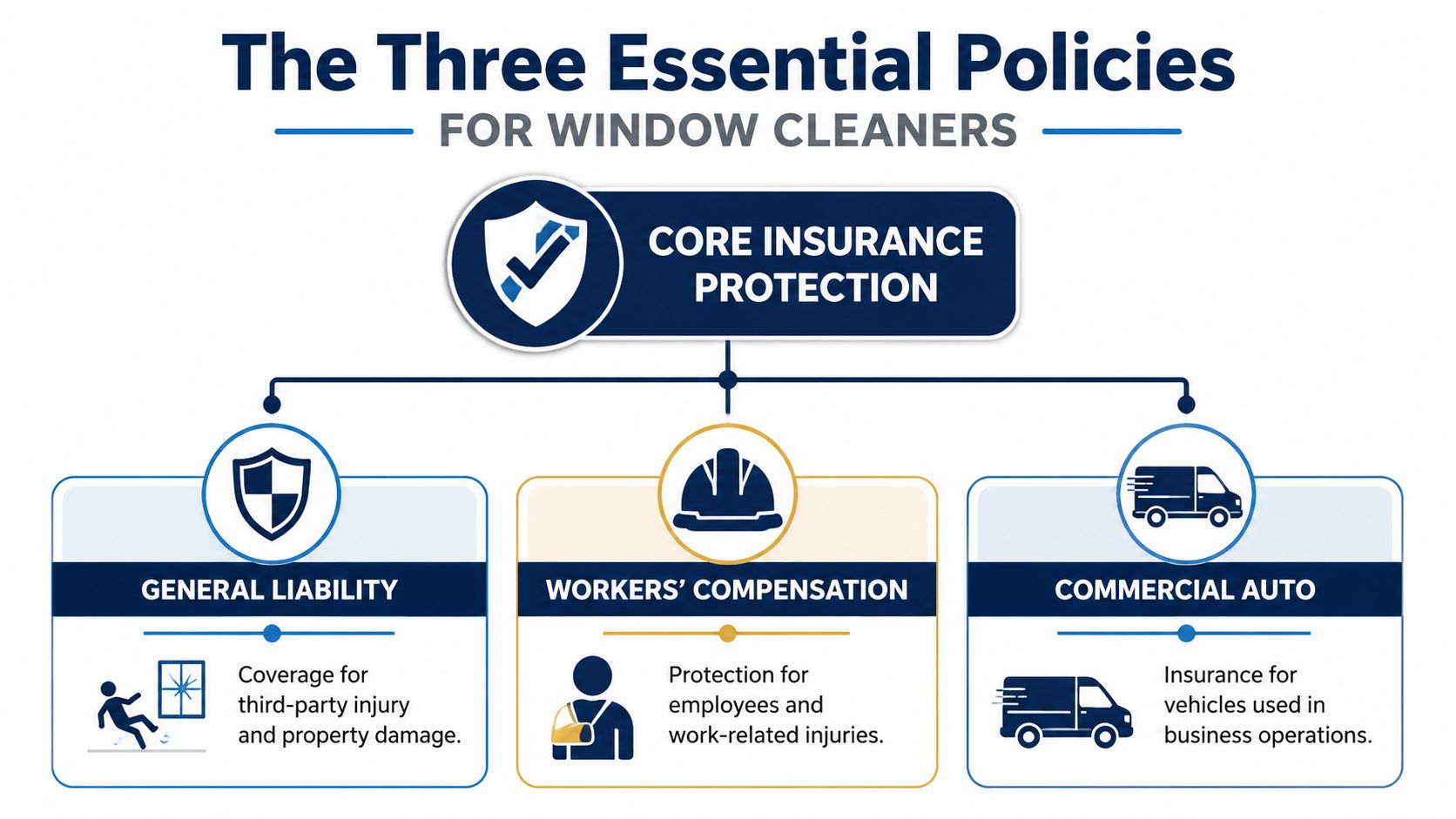
That is why these three policies matter early. They handle three different claim buckets, and each one has limits that matter more for window cleaners than for many other trades.
General liability handles damage to other people and their property
General liability is usually the first policy on the checklist because it deals with third-party injury and third-party property damage claims tied to the business's operations. For a cleaner bidding commercial work, it is often the baseline policy behind a general liability insurance setup for contractors.
On a window cleaning job, that can mean a pedestrian slipping near the work area, a tool falling and damaging property below, or a lawsuit over alleged damage that still has to be defended even if the claim is weak.
Here is the trade-off. General liability is necessary, but it does not solve every glass-related loss.
If a tech drops a tool and cracks a sign, dents a parked car, or injures someone on the sidewalk, general liability is the right place to start. If the glass being cleaned breaks while it is in your crew's active control, the claim can run straight into the care, custody, and control exclusion. That is one of the biggest misunderstandings in this trade. Many owners assume "glass breakage" automatically falls under general liability. It often does not, at least not without the right wording, endorsements, or a carrier that understands how window cleaning work is done.
Contractors trying to secure your window cleaning operations usually begin with general liability. Smart operators also ask what it will not pay for.
Workers' comp protects the crew
Workers' compensation covers employee injuries that arise out of the job. For window cleaners, that exposure is constant. Ladder work, roof access, wet surfaces, repetitive shoulder movement, and harness use all increase the odds of a claim.
A technician falls from a ladder while finishing a second-story job. Another strains a shoulder after weeks of pole work. Those are workers' comp problems, not general liability problems. Medical bills, lost wages, and employer obligations can get expensive fast, especially if a business is already tight on cash flow.
Height also affects underwriting. A cleaner doing mostly ground-level storefront work is a different insurance risk than a crew handling multi-story commercial buildings. As height goes up, premiums often follow. Some carriers also get stricter about training, fall protection, and the type of access equipment used.
One bad injury can change a small company's year.
Commercial auto covers business vehicles, not just the driver
Window cleaning companies live out of their vehicles. Ladders, poles, tanks, hoses, and purification systems travel all day. If the van is in an accident on the way to a job, that loss belongs under commercial auto, not general liability.
It's common for owners to get caught using a personal policy for a work vehicle. If the vehicle is titled to the business, outfitted for the business, or used daily for service calls, personal auto coverage can leave ugly gaps at claim time.
Commercial auto also matters beyond collision damage. It can include liability for injuries or damage caused by the vehicle, and those claims can be much larger than the cost to repair the van itself.
Core policies at a glance
| Policy | What it protects | Common trade example |
|---|---|---|
| General Liability | Third-party injury, third-party property damage, and legal defense for covered claims | A passerby slips near the work area or a dropped tool damages property below |
| Workers' Compensation | Employee job-related injuries and related employer obligations | A tech falls from a ladder or suffers a work-related strain injury |
| Commercial Auto | Vehicles used in business operations and liability tied to those vehicles | A service van causes an accident while traveling between jobs |
The right question is not which policy matters most. The right question is which loss would put the business in a hole if it happened next week. For window cleaners, the answer is usually all three, with special attention to the glass-in-your-care gap that standard general liability may leave behind.
Protecting Your Tools and Equipment
A window cleaning company can't work without gear. Water-fed poles, ladders, squeegees, harnesses, pumps, hoses, and purification systems are the income engine. If that equipment is stolen or damaged, jobs stop.
The first thing to sort out is location. Insurance for movable tools isn't the same as insurance for property kept at a fixed place.
Gear on the move needs one kind of policy
When tools travel from job to job, the policy often discussed is Inland Marine, sometimes written as tools and equipment coverage. This is the coverage built for gear that moves.
The practical example is common. A crew parks a van at a jobsite. After the job, they return and find the side door forced open and the poles, harnesses, and other equipment gone. That's not a problem solved by general liability. It's a first-party property issue involving the business's own gear.
For contractors using more advanced ladder and access setups, safe handling matters as much as insurance. Operational discipline around setup, transport, and work at height can be strengthened by reviewing professional high window cleaning methods, especially when the business relies on specialized gear every day.
If the equipment earns money while moving between jobs, it needs coverage built for property in transit and at temporary locations.
Gear at a fixed location needs another
Commercial property insurance is different. It's usually meant for equipment, materials, and contents kept at a fixed insured premises such as an office, warehouse, or storage unit.
That distinction matters because many contractors assume “tools are insured” without asking where the insurer expects those tools to be. A break-in at a storage unit may fall under a different policy structure than a theft from a van parked outside a customer site.
A good review usually includes:
- A current equipment list: Include poles, ladders, safety gear, pumps, and any specialized systems.
- Real replacement values: Understating values may save premium up front but can hurt after a loss.
- Storage habits: Gear left overnight in vehicles may be treated differently than gear secured at a listed location.
The mistake here isn't usually buying no coverage. It's buying the wrong kind and finding out after the theft.
Critical Endorsements and Hidden Coverage Gaps
A lot of generic advice tells window cleaners to buy general liability and move on. That's not enough for this trade. The dangerous gaps usually show up in the claims a cleaner thought were already covered.
Why general liability can fail on broken glass
This is one of the biggest misunderstandings in window cleaning insurance. A contractor buys general liability, sees a decent limit on the declarations page, and assumes broken glass is covered. Sometimes it isn't.
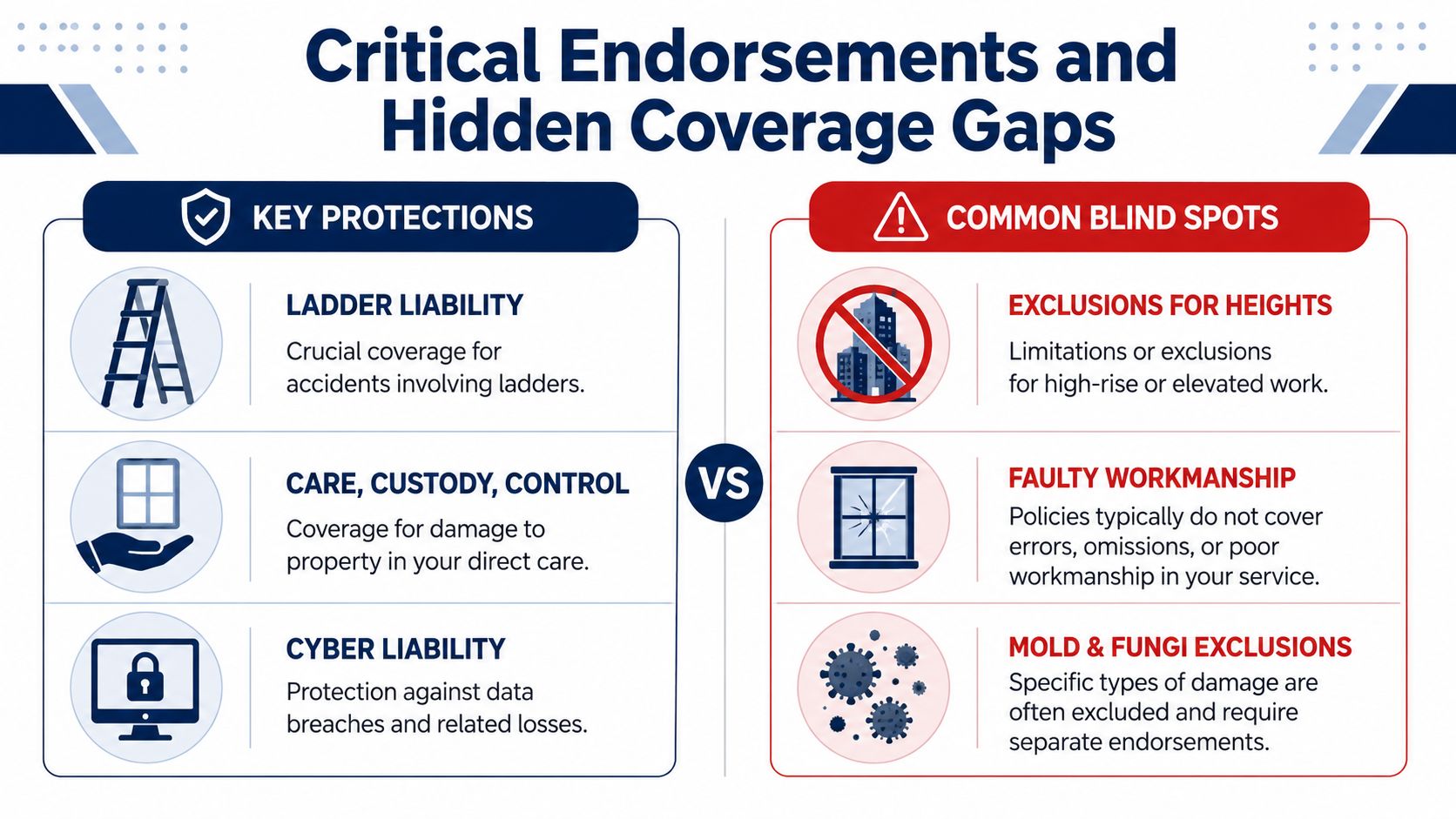
Standard General Liability often denies claims for a broken window because it was the client's property in the cleaner's Care, Custody, and Control. While cleaners spend about $60 per month on GL, they often overlook specific CCC endorsements needed to cover their own errors, leaving a massive exposure gap when a $300-plus window is scratched or broken during cleaning (coverage gap explanation for window cleaners).
That's the key distinction. General liability is built for damage to third parties. The glass being actively cleaned may be treated differently because it's in the contractor's control at the time of the loss.
A trade example makes this real. A technician uses the wrong scraper technique on tempered glass and leaves visible scratches across a panel. The building owner expects payment. The cleaner assumes the GL carrier will step in. Then the denial letter points to Care, Custody, and Control.
Height changes the insurance conversation fast
Height changes underwriting, pricing, and even eligibility. Carriers look at a first- and second-story residential cleaner differently than a contractor taking on high-rise commercial work.
The same source notes that businesses working above three stories can face much steeper pricing and may need specialized treatment beyond a standard setup. That's where many contractors get burned. They buy a policy that fits low-rise work, then start accepting taller jobs without confirming whether the policy allows it.
A cheap policy for low-rise work can become an expensive mistake the first time a contractor takes a taller job outside the policy's comfort zone.
Questions worth asking before binding:
- Height limit: What building height does the carrier contemplate?
- Access method: Are ladders, lifts, rope descent, or roof access treated differently?
- Commercial concentration: Does the policy fit mixed work or mostly residential?
- Glass in control: Is there any endorsement addressing Care, Custody, and Control?
Contract requirements can create coverage gaps too
Clients don't just ask for “insurance.” They ask for very specific insurance language. One owner may want additional insured status. Another may require primary and noncontributory wording. A management company may want evidence that the cleaner's policy responds before theirs does.
That's why endorsements matter. A certificate alone doesn't change coverage. The underlying form has to support what the certificate is showing. Contractors dealing with owner and tenant demands often run into additional insured endorsement issues long before a claim ever happens.
A cleaner who understands these hidden gaps asks better questions. That usually matters more than chasing the cheapest premium.
How Your Premiums Are Calculated
Most cleaners want a simple rate card. Carriers don't price it that way. They look at the operation, not just the trade name.
What carriers actually look at
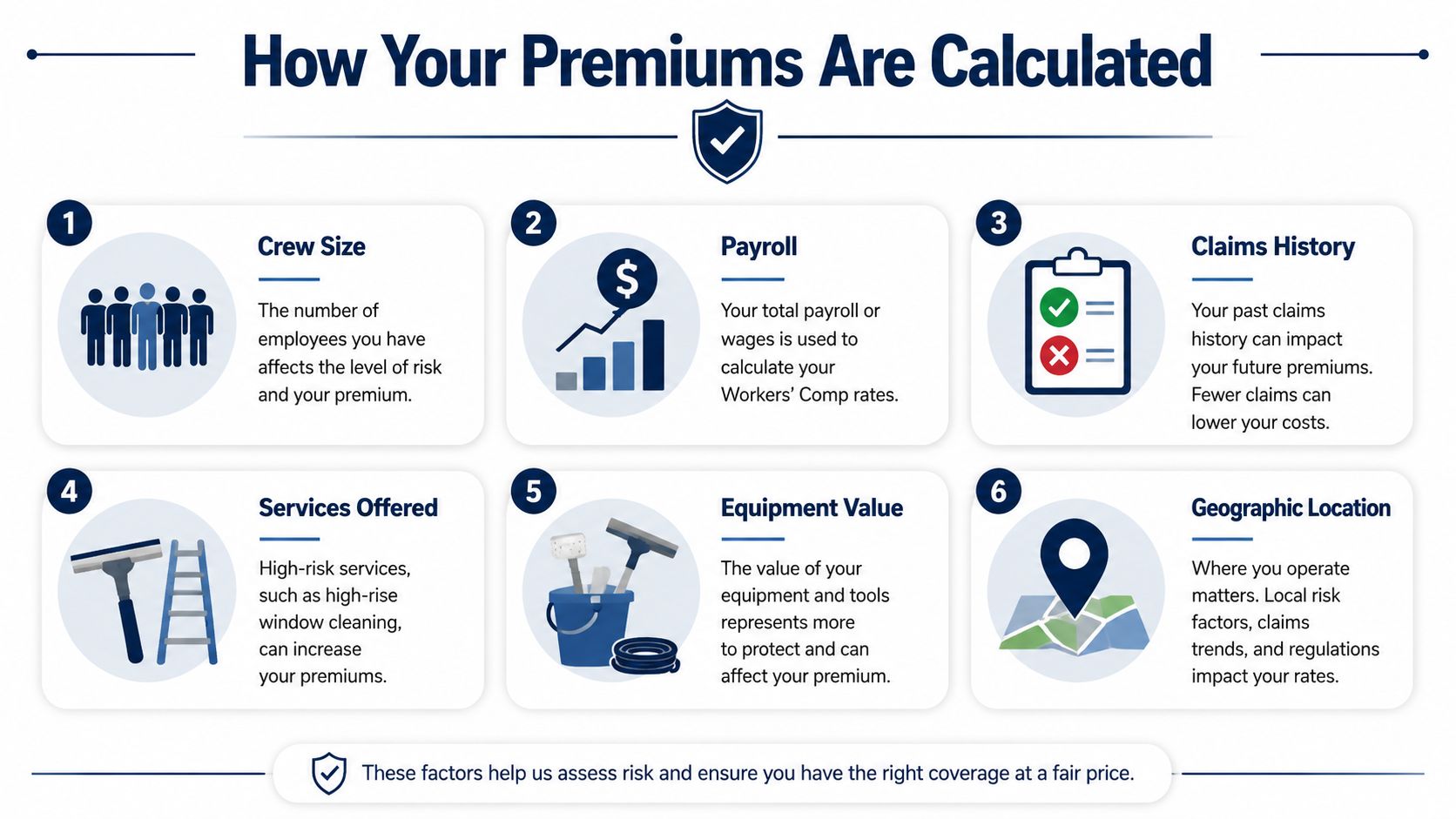
A premium usually moves based on exposure. For window cleaning, the common drivers include:
- Crew size: More workers usually means more injury exposure.
- Payroll: This especially affects workers' compensation.
- Claims history: Prior losses tell underwriters how the operation has performed.
- Services offered: Basic residential routes are different from taller commercial work.
- Equipment and vehicle use: More moving parts usually mean more ways a claim can happen.
- Geographic location: State rules and local conditions can change pricing and coverage needs.
The workers' comp piece often surprises solo owners. The rule of thumb is not always “no employees, no problem.” State requirements and certain contract types can pull a one-person operation into the workers' comp conversation anyway. Contractors trying to make sense of those moving parts should understand how workers' compensation insurance premiums are shaped, because payroll, classification, and job duties matter.
The averages help with budgeting, not with quoting
For 2026 projections, the average annual cost for window cleaning insurance is approximately $1,165, while general liability averages about $60 per month and workers' compensation averages about $136 per month. The same analysis notes that businesses working above 3 stories or in high-risk states can see premiums double (2026 projected window cleaning insurance costs).
Those numbers help with budgeting, but they shouldn't be treated like a guaranteed quote. A one-person operator cleaning low-rise residential jobs won't be viewed the same way as a contractor running multiple employees, vehicles, and taller commercial accounts.
A cleaner can still influence price through risk control. Carriers generally like operations that document training, maintain vehicles, control who climbs, and avoid sloppy claims frequency. The business can't change the nature of window cleaning as a high-risk trade, but it can show that the operation is organized.
Clean loss history, clear job descriptions, and honest reporting usually do more for long-term premium stability than shopping only on price.
Using COIs and Managing Subcontractor Risk
A certificate of insurance, or COI, is one of the most useful documents in the trade when it's handled correctly. It helps prove the business is insured, but it also reveals whether a sub is bringing risk onto the job.

What clients want to see on a COI
When a client asks for a COI, they're usually checking whether the business carries the required coverages and whether the limits line up with the contract. For bigger properties, those requirements can be much higher than what a small cleaner carries by default. For window cleaning businesses operating on larger properties like hotels or mid-rise buildings, clients often require general liability coverage between $2 million and $5 million, a requirement that separates qualified contractors from smaller operators who only carry the standard $1 million limit (commercial client limit expectations for window cleaners).
That's why a COI matters in sales. It tells the client whether the cleaner can satisfy the job requirements.
Common items clients watch for:
- Named insured accuracy: The business name has to match the contract.
- Policy dates: Expired coverage kills deals fast.
- Correct limits: The numbers on the certificate have to meet the contract.
- Endorsement-backed requests: If the contract asks for special status, the policy needs to support it.
What to demand from subs before they step on site
A lot of window cleaning businesses use helpers, overflow crews, or specialty subs. That's where subcontractor risk starts. If a sub drops a tool, injures someone, or causes property damage, the hiring contractor can still get pulled into the claim.
That's why every sub should provide a current COI before stepping onto a job. The business also needs to know what insurance standards to require. A starting point is a clear set of subcontractor insurance requirements for contractors, including the right coverage types, active dates, and consistency with the subcontract terms.
A practical review of a subcontractor COI should check:
- General liability is active
- Workers' comp is active if the sub has employees
- Commercial auto is active if vehicles are part of the work
- The listed entity matches the actual subcontractor
The paperwork matters because claim finger-pointing starts fast after an accident. Clean documentation before the job is cheaper than sorting blame out later.
Get the Right Coverage for Your Business
Window cleaning insurance works best when it matches the actual way the business operates. A cleaner doing residential homes with one truck has one risk profile. A contractor chasing retail, hotel, or mid-rise work has another. The policy set shouldn't be built from guesswork or from whatever happened to be cheapest online.
The smart approach is practical. Lock down the essential policies. Protect the tools that keep the schedule moving. Fix the hidden gaps, especially around glass in the contractor's control and work performed at height. Make sure certificates and endorsements line up with client contracts before the job starts, not after there's a problem.
This trade doesn't leave much room for vague coverage. One broken window, one injured worker, one van crash, or one uninsured subcontractor can erase months of profit. Good insurance won't stop accidents, but it can keep one bad day from turning into a business-ending event.
A proper review should answer simple questions in plain language. What's covered. What isn't. What changes when the business hires, adds vehicles, or starts bidding taller jobs. That's the level of clarity a contractor needs.
If the business needs a free quote or a no-obligation coverage review, Coverage Axis can help evaluate the current setup, identify coverage gaps, and match the insurance program to the kind of window cleaning work being performed.